From Blurry Vision To Perfect Sight: The Real Day-by-Day ICL Eye Surgery Journey No One Talks About

You have worn glasses for years. You researched laser surgery and were told you are not a candidate — corneas too thin, prescription too high, dry eye too significant. Then someone mentions ICL. Most articles describe what it is and what it achieves. What they rarely give you is the honest, day-by-day account of the experience — the morning of surgery, the first clear glimpse, the temporary quirks of recovery, and the moment weeks later when it finally settles in that you genuinely do not need glasses anymore. This guide provides exactly that, alongside everything you need to know about ICL eye surgery and treatment in Chinchwad.
What Is ICL and Why Is It Different from LASIK?
ICL stands for Implantable Collamer Lens — a soft, flexible micro-lens made from a biocompatible collagen-based material (collamer) that is surgically placed inside the eye, between the natural lens and the iris. It functions as a permanent contact lens that you never have to remove, insert, or replace, correcting your vision from inside the eye itself.
The critical difference from LASIK is what is not done: no corneal tissue is removed, no flap is created, and the corneal surface is not altered in any way. This makes ICL suitable for patients who cannot have LASIK due to thin corneas, high prescriptions, or dry eye concerns. ICL for dry eyes patients is one of the most significant clinical advantages of the procedure — because the corneal nerves are not disrupted (they are the main driver of post-LASIK dry eye), ICL does not worsen and in most cases does not significantly affect pre-existing dry eye at all.
ICL corrects myopia up to -18 dioptres, hyperopia up to +10 dioptres, and significant astigmatism, with outcomes matching or exceeding LASIK for equivalent prescriptions. The lens is removable if needed, making ICL technically reversible in a way that LASIK is not.
Before the Surgery: The Pre-Operative Assessment
The ICL journey begins weeks before the actual procedure with a comprehensive pre-operative assessment at a quality eye specialist in chinchwad clinic. This appointment is not a formality — it determines whether you are a suitable candidate, which lens size and power to order, and what the surgical plan will be.
The assessment measures your full refraction, corneal surface topography, anterior segment OCT for the vault distance between the natural lens and cornea, and a dilated fundus examination. The vault measurement is the most surgically critical parameter — too close risks cataract formation, too far risks corneal contact. The ICL is manufactured to your specific measurements and takes 2 to 4 weeks to arrive. This is the production window for a custom medical implant, not a queue.
What to bring to your pre-operative assessment: Stop wearing soft contact lenses for at least 3 days (and rigid gas-permeable lenses for 3 weeks) before the assessment. Lenses alter corneal shape, and measurements taken while lenses are being worn are less accurate. Bring your current spectacle prescription for reference. Have someone drive you home since your pupils will be dilated.
The Night Before: What to Expect
Your surgeon will prescribe prophylactic antibiotic eye drops to begin the evening before surgery. These are started to reduce the bacterial load on the ocular surface before the procedure. You will be asked not to wear eye makeup, perfume, or aftershave on the day of surgery, and to arrange for someone to drive you to and from the clinic since you will not be permitted to drive after the procedure.
Most patients feel a mix of anticipation and mild anxiety. The most useful thing to understand is that ICL surgery is a brief, painless procedure under anaesthetic eye drops — no injections, no general anaesthesia, and no requirement to lie still for extended periods. Surgical time is 15 to 30 minutes per eye, most of which is preparation and positioning.
The Day of Surgery: An Hour-by-Hour Account
On arrival: Nursing staff instil dilating drops repeatedly over 30 to 45 minutes to fully dilate your pupils before surgery. During this time you sit in a waiting area. Vision becomes progressively blurred and light sensitivity increases — this is expected and temporary. Antibiotic drops and a mild sedative may be given at this stage depending on the clinic's protocol.
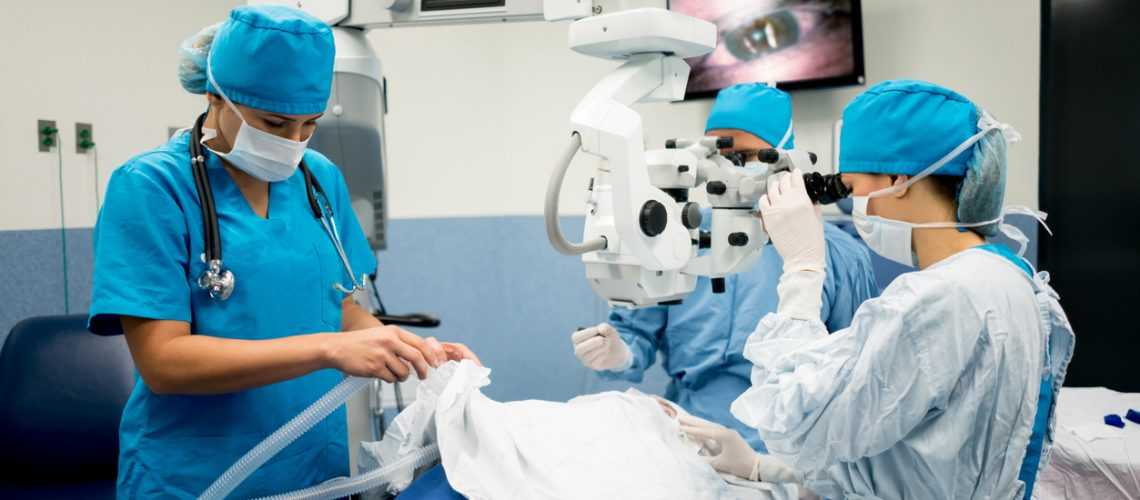
In the operating room: You lie on a reclining chair or surgical table. Anaesthetic drops are instilled into the eye — there are no injections. A speculum holds the eyelid open gently so you do not need to consciously avoid blinking. A tiny incision (approximately 3 mm) is made at the periphery of the cornea. The ICL, rolled to a tiny diameter, is injected through this incision using a specifically designed inserter. The lens unfurls inside the eye and is positioned behind the iris. The incision is self-sealing and requires no sutures in most cases. The whole process from first incision to lens positioning takes 5 to 10 minutes per eye.
Immediately after: You are moved to a recovery area. Vision in the operated eye is blurry — this is expected and normal. Most patients describe seeing a foggy brightness rather than clear vision at this point. A protective shield is taped over the eye. The other eye is then treated if bilateral surgery is performed on the same day (which is the standard approach at most clinics).
Day 1 Post-Surgery: The First Morning Without Glasses
The morning after ICL surgery is the moment patients most commonly describe as life-changing. You wake up, open your eyes, and without reaching for glasses the room is clear — not sharp-photograph perfect in the first hours, but genuinely, clearly functional. Most patients experience some or all of the following in the first 24 hours, all normal and expected:
- Halos and starbursts around lights: Particularly noticeable at night. Street lights, phone screens, and lamps appear to have rays or rings around them. This is caused by the interaction of light with the pupil margin and the edge of the ICL during the dilated recovery period. It typically reduces significantly within 1 to 2 weeks
- Mild light sensitivity: Bright light feels slightly uncomfortable. Sunglasses outdoors are recommended for the first few days
- Mild foreign body sensation: A slight grittiness or awareness in the eye. This is from the incision site rather than the lens itself and typically resolves within 2 to 3 days
- Fluctuating vision: Vision may be slightly different between morning and evening on day 1. This settles as the lens fully settles in position and the eye adapts
The post-operative check on day 1 confirms lens position, vault measurement, and intraocular pressure. For patients at a quality ICL eye surgery and treatment near Chinchwad clinic, this review appointment is when the treating surgeon gives the first objective confirmation that the lens is sitting correctly and vision is on track.
Days 2 to 7: The First Week
The first week is when most patients make the transition from "I can see without glasses" to "I cannot believe I can see without glasses." The improvements across the week are progressive and perceptible day by day.
The halos and starbursts around lights typically reduce noticeably between days 3 and 7. By the end of the first week, most patients are functioning normally in all daily activities including reading, computer work, and driving in daylight (nighttime driving readiness should be confirmed with your surgeon at the one-week review before resuming). The eye drop regimen — typically antibiotic and anti-inflammatory drops — continues through the first week as prescribed.
Physical activity restrictions apply for the first week: no swimming, no contact sports, no heavy lifting, and no eye rubbing. Showering is permitted but water should not enter the eye directly.
The most common thing patients say at their one-week review: "I cannot believe how clearly I can see. I keep reaching for my glasses first thing in the morning and then remembering I don't need them." This moment — the phantom reach for glasses that are no longer needed — is one of the most universally reported post-ICL experiences. It typically stops within 2 to 3 weeks as the new reality becomes the default expectation.
Weeks 2 to 4: Settling In
By the second week, the vast majority of patients are living normally without glasses or contact lenses. Night halos have reduced to a level most describe as mild and no longer distracting. The one-month review confirms stable vault, normal intraocular pressure, and settled refraction. Vision correction with ICL is considered complete when refraction has stabilised and vault measurement confirms correct long-term positioning. Some patients with higher prescriptions notice the final settled vision differs slightly from the first-week reading as the eye fully adapts — the one-month refraction is the accurate outcome measurement.
ICL vs LASIK: The Honest Comparison for Chinchwad Patients
| Factor | ICL | LASIK |
|---|---|---|
| Suitable for thin corneas | Yes | No |
| Suitable for high myopia (>-8) | Yes | Limited |
| Post-operative dry eye risk | Very low (corneal nerves intact) | Moderate to significant (corneal nerve disruption) |
| Corneal tissue removed | No | Yes (irreversible) |
| Reversibility | Lens can be removed if needed | Not reversible |
| Visual quality | Excellent, especially contrast sensitivity | Excellent for suitable prescriptions |
| Recovery to normal activities | Most activities by day 3 to 7 | Most activities by day 1 to 3 |
| Cost | Higher than LASIK | Lower than ICL |
For patients researching best ICL surgery Chinchwad options, ICL is the superior choice for patients with thin corneas, high prescriptions, or significant dry eye concerns — not merely an alternative to LASIK.
What Makes a Good Candidate for ICL?
You are likely a strong candidate for ICL eye surgery and treatment in Chinchwad if you are between 21 and 45 with a stable prescription for at least 12 months, your prescription is within ICL range, and your anterior chamber depth and corneal endothelial cell count are adequate. Specs removal with ICL is possible for a wider range of patients than LASIK — it is the preferred option for those told they cannot have LASIK. A pre-operative assessment at a qualified eye hospital in chinchwad confirms definitively whether your measurements qualify.
FAQs: ICL Eye Surgery in Chinchwad
Q1: Is ICL eye surgery painful?
No. The procedure uses anaesthetic eye drops — no injections into or around the eye. Most patients feel pressure but not pain. Post-operative grittiness and sensitivity for 2 to 3 days is managed with prescribed drops. The phrase "surprisingly comfortable" appears consistently in patient accounts of ICL eye surgery and treatment in Chinchwad.
Q2: Will I see clearly immediately after surgery?
Vision improves dramatically within the first few hours. Most patients function normally without glasses by the morning after the procedure. Vision continues to stabilise over 2 to 4 weeks. Halos and light sensitivity in the first week are normal. The final settled vision is assessed at the one-month review at your affordable ICL eye surgery and treatment in Chinchwad clinic.
Q3: How long does ICL last?
The EVO ICL is designed to be permanent — it does not degrade or require scheduled replacement. If a natural age-related cataract develops years later, the ICL can be removed and a standard cataract IOL inserted in the same procedure. It does not affect the eye's natural ageing process or interfere with future cataract surgery.
Q4: I have been told I have dry eye and cannot have LASIK. Can I still have ICL?
Yes, this is one of the most important clinical advantages of ICL eye treatment. Because ICL does not involve any incision in the corneal surface and does not disrupt the subepithelial corneal nerves that drive the neurotrophic reflex arc of tear production, it does not cause the post-operative dry eye that is a recognised complication of LASIK. Patients with mild to moderate pre-existing dry eye can typically have ICL surgery with appropriate pre- and post-operative ocular surface management. Severe dry eye does require assessment, but dry eye that disqualifies a patient from LASIK does not automatically disqualify them from ICL. Ask your
Q5: What is the total cost of ICL eye surgery in Chinchwad and what does it include?
ICL surgery costs more than LASIK, primarily because the ICL itself is a custom-manufactured medical implant sized to the individual patient's eye. The total cost includes the pre-operative assessment and measurements, the ICL lens itself (manufactured by STAAR Surgical to your specific dimensions), the surgical procedure fee, the post-operative medications, and the follow-up review appointments. Always ask whether the quoted price is all-inclusive or whether any of these components are charged separately. A clinic offering affordable ICL eye surgery and treatment in Chinchwad that is transparent about the all-in cost — with no unexpected charges appearing after the procedure — is the right basis for a financial decision. EMI payment plans are available at most quality eye surgery centres and make the total investment more accessible across monthly instalments.
Conclusion: The Journey Is Shorter Than You Think
The ICL eye surgery journey from pre-operative assessment to fully settled vision spans approximately 4 to 6 weeks. Within that window, the actual surgical experience takes under an hour. The recovery is measured in days for the major milestones — functional vision on day 1, return to normal activities by day 3 to 7, and fully stable vision within the first month.
What most patients describe after that journey is not just clear vision — it is the freedom that comes with it. Swimming without fumbling for glasses at the poolside. Waking up and seeing the room immediately. Travelling without worrying about contact lens solutions. Playing sport, going to the gym, walking in the rain without the constant management that glasses and contact lenses require.
If you have been considering ICL eye surgery and treatment in Chinchwad and wondering what the experience is actually like beyond the clinical description, the honest answer is that most patients say the same thing: they wish they had done it sooner. Book your pre-operative assessment at a trusted ICL eye surgery and treatment near Chinchwad clinic today and find out whether you are a candidate.
Source: From Blurry Vision to Perfect Sight: The Real Day-by-Day ICL Eye Surgery Journey No One Talks About
Author Bio
Article Comments
No Comments!
At present there are zero comments on this article.
Why not be the first to make a comment?
Similar Articles
Search Pages
Upgrade User Account
account to full use of editor,
including hyperlinks
Article Categories
There are zero sub-categories in this parent category.
There are zero sub-categories in this parent category.
Featured Articles



Featured Article Authors